
Olathe Directory Collections by Year
The verified Olathe city directory shelf has both a strong printed spine and important gaps. Johnson County Library catalogs R.L. Polk's Olathe directory including Gardner for in-library use. FamilySearch results identify several individual volumes, but access can be image-only, indexed, restricted by location, or absent for a given item. A search lead from 1908 still needs library or catalog help because no stable open image was confirmed.
| Collection | Years | Where Held | Access |
|---|---|---|---|
| R.L. Polk, Olathe including Gardner | 1961-1984 catalog run | Johnson County Library | In-library use |
| Located FamilySearch volumes | 1961, 1964, 1966, 1968, 1977-1985 | FamilySearch Books and collection records | Index, image, or site access varies |
| Early Olathe directory lead | 1908 | U.S. City Directories collection and library catalog help | No stable open image confirmed |
| Street index or reverse section | Year-specific, not fully inventoried | Genealogy Desk and individual volume | Inspect front matter in person or in image |
| Local history companions | Nineteenth century to present, by collection | JCL, OPL, JoCoHistory, OHS | Online, database, microfilm, or request |
The located list is not a complete publication record. A missing year in search results does not prove that no volume was issued. The exact first printed year, last printed year, and year-by-year reverse-section coverage remain unconfirmed, so cite only the item actually used.
Olathe's R.L. Polk Spine
The Johnson County Library catalog record names the title as Olathe (Johnson County, Kansas) City Directory Including Gardner, published by R.L. Polk & Co. of Kansas City, Missouri. Its catalog run covers 1961 through 1984 and is marked for in-library use. That is the most reliable local statement of the printed collection.
The catalog screen helps distinguish the held title from the broader national directory database.
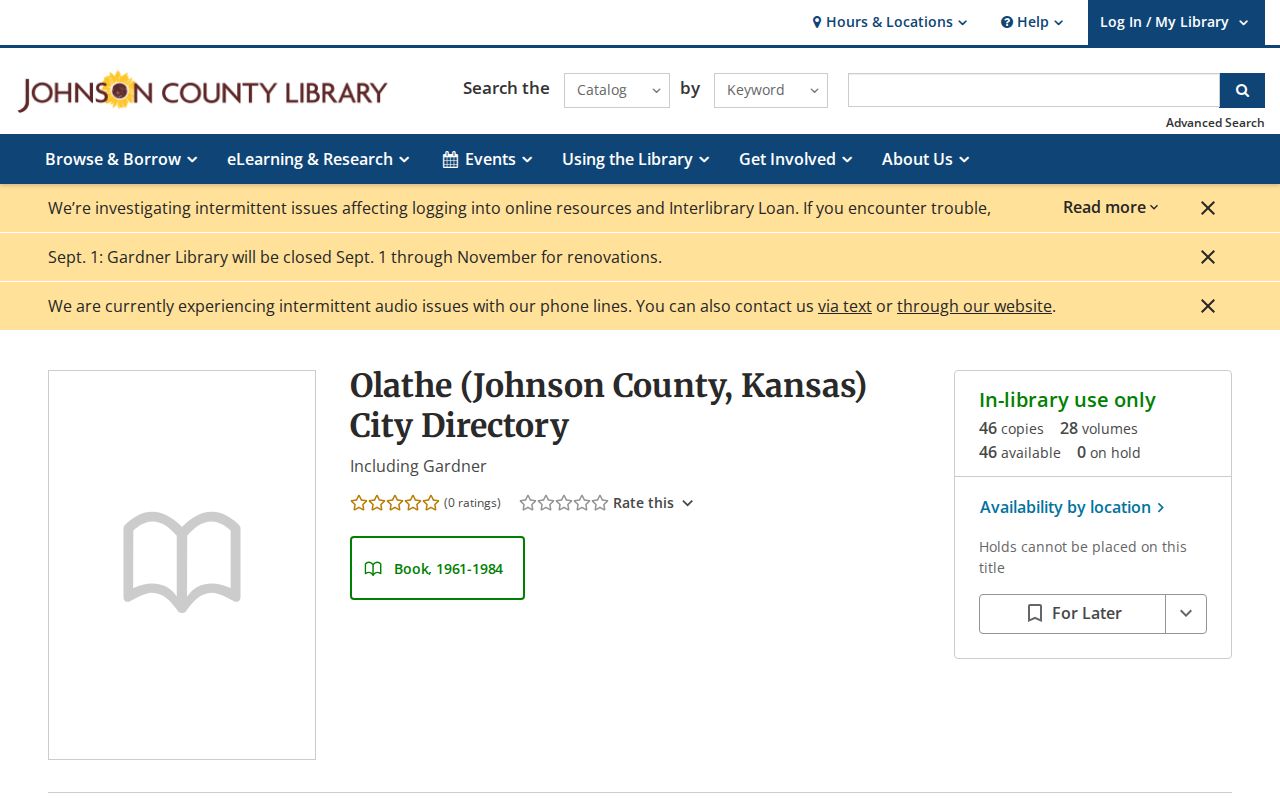
Use the title, year, publisher, and library record together when requesting a volume, since a generic Polk search may return another city or an adjoining-place edition.
Olathe Directory Help at JCL
The Johnson County Library Genealogy Desk at Central Resource Library is the main hands-on route. The library and Johnson County Genealogical Society have worked together since 1972. Listed volunteer hours are Monday through Saturday from 9:00 to 4:00 and Sunday from 2:00 to 4:00. Check current hours before a visit.
Research computers, books, microfilm and microfiche, maps, yearbooks, an old-book cabinet, local history files, and an obituary card catalog are available. The obituary cards are described as roughly 1977 through 2000, which makes them a useful index but not a complete death file. Volunteers can help identify an edition, locate an abbreviation key, or test whether a year has a street section.
The Genealogy Desk page shows the library route for in-person Olathe city directory research.
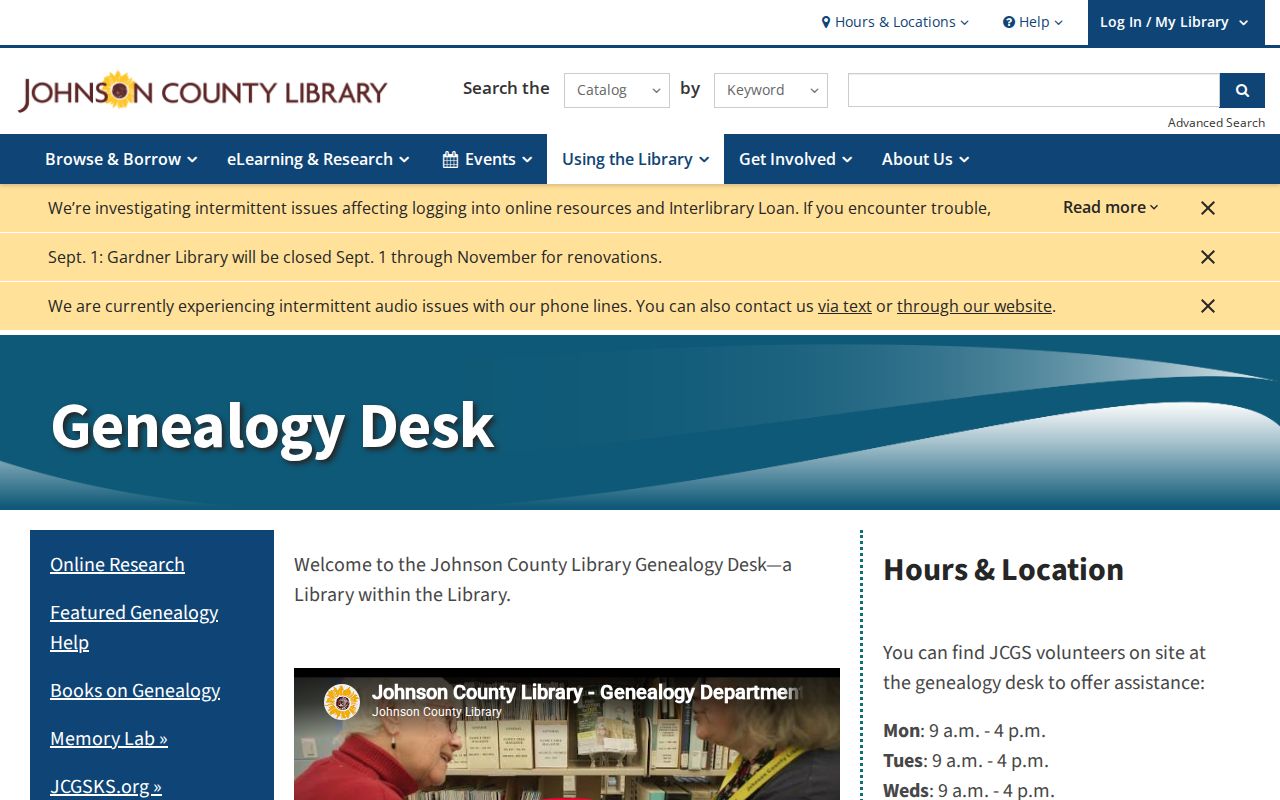
The desk is especially useful when the public catalog confirms a title but not a volume's street index, microfilm form, or local access state.
Digitized Olathe Directory Years
The FamilySearch Books catalog produced Olathe volume leads for 1961, 1964, 1966, 1968, and 1977 through 1985. Noted page counts range from 359 pages for 1966 to 1,083 pages for 1985, with the 1961 item identified as 806412. These counts help identify the right digital object, but they say nothing about whether a street index appears in that year.
The broader U.S. City Directories collection spans about 1749 to about 1990 and may expose names, addresses, and occupations. Index and image rights differ by item and location. Save the item identifier, page number, image number, and access state. Do not cite a search snippet as if the page was reviewed.
For 1908, the safe route is JCL's in-library databases or catalog assistance. The research session found the Olathe lead but not an exact free-image URL.
Olathe Local History Beyond Directories
Johnson County Library local history connects researchers to JoCoHistory and more than 40,000 historical photographs, newspapers, maps, and related items. Olathe Public Library adds local holdings and JoCoHistory participation. Its institutional story runs from two City Hall rooms to the Carnegie Library era.
The screenshot from the JCL local history resource shows the companion collections available when a city directory entry needs context.
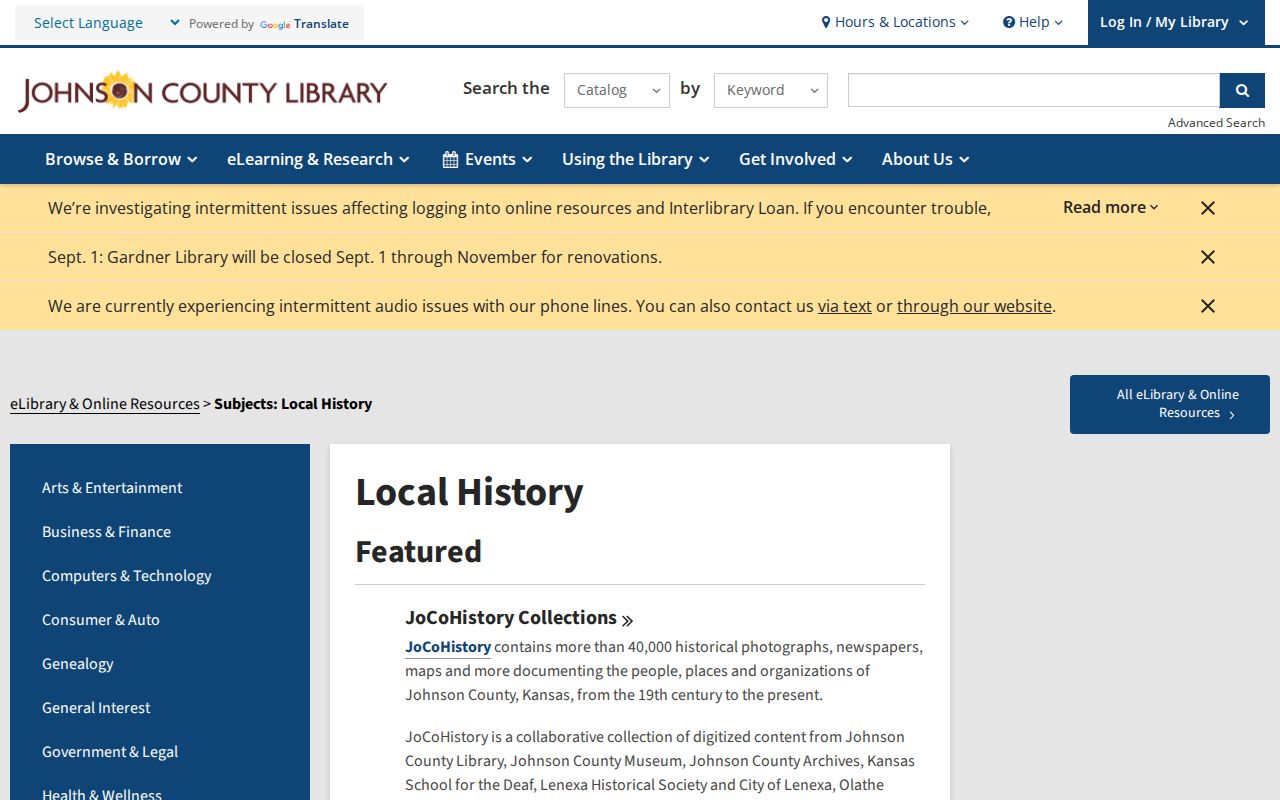
A map, photograph, obituary citation, or newspaper page can explain an address or name change, but each item needs its own date and collection identifier.
Read an Olathe Directory Entry
An Olathe city directory entry must be read with the key printed in that exact volume. R.L. Polk runs often organize residents by surname and may add business sections, but the fields and abbreviations can change by year. No personal sample or local abbreviation page was captured, so the inventory below describes fields to check, not a made-up Olathe resident.
| Name | Surname, given name or initial, suffix, and widow notation if the key supports it |
|---|---|
| Address | Street number and name, with a unit where printed |
| Household mark | Spouse in parentheses or another marker only when defined by that volume |
| Business or occupation | Role, business name, or business address when included |
| Telephone | Number or business listing in years that print one |
| Citation | Directory year, publisher, page or image, and section |
- Criss-cross directory
- A section arranged by street or address, used to move from a known place to a listed name.
- Householder index
- An address-oriented list of the primary names printed for homes, not a full count of all occupants.
- Abbreviation key
- The volume's own legend for shortened roles, relationship marks, street forms, and symbols.
Photograph or save the key before transcribing the entry. Keep initials as printed, and do not assume that two people with the same name are one person.
Street Changes in Olathe Directories
An address can disappear because the road name or numbering changed, not because the household moved. Olathe's historical forms include Black Bob and Lackman, Lone Elm and Parker or K-7, Mur-Len, Santa Fe, Sheridan and 143rd in some segments, and Strang Line. The city chronology also says the east side used Kansas City, Missouri street numbering, though the exact change date was not found.
Test the old and new name in the alphabetical section, street index, newspapers, and maps. Then use a legal description, adjoining road, or Sanborn block to bridge the old address to the current parcel. The modern address-keyed method belongs to the Olathe street directory; the historical volume should keep the original wording intact.
Note: A corrected modern address should never replace the historic address in a citation; record both strings and explain the source of the match.
Olathe Yearbooks and Obituary Cards
Yearbooks can bridge a student name to a school, class year, photograph, and community. JCL and Olathe Public Library are the sound starting points. The Olathe School District Alumni Association and MidAmerica Nazarene University's Marge Smith Archives are targeted institutional leads, not open master lists. Ask for a school, year, and name.
JoCoHistory's obituary index reaches from the late nineteenth century to the present as a citation and copy-request route. JCL also lists Olathe News full text for December 2006 through 2015 and older local newspaper material. A citation may reveal relatives, a former street, a cemetery, or a date that tests the directory trail.
The Olathe Historical Society adds photographs, oral-history transcripts, timelines, essays, and local publications. Search an item and its date, not a broad private roster.
Trace Family Through Olathe Directories
City directories fill the years between census snapshots. They are most useful when each appearance is treated as a dated claim and compared with neighboring volumes. Kansas state census records, federal census records through the latest public release, newspapers, deeds, maps, and obituary sources can then test the same household.
- Find the earliest confirmed name entry. Save the Olathe city directory title, year, publisher, page, spelling, and access state.
- Check the year before and after. Note moves, initials, spouse marks, occupations, and gaps without guessing why they changed.
- Inspect the street index or reverse section if that volume has one. Compare nearby addresses and preserve the printed road form.
- Pair the directory year with the closest state or federal census. Keep the enumeration date distinct from the publication year.
- Test the trail in deeds, tax or AIMS records, newspapers, yearbooks, obituary citations, and cemetery records.
A missing name may mean a move, death, omission, spelling shift, unlisted status, or a gap in the surviving collection. The next directory, a local newspaper, and an obituary card often separate those possibilities. The 1890 federal census loss makes local Olathe city directories and county records especially useful around that decade.
Olathe's record timeline also changes the source mix. Early county taxes and marriages begin in the territorial era, Sanborn maps start in 1884, the verified Polk spine begins in 1961, and local history collections preserve the links between those periods.